F75P
Vital Embedded Single Board Computer, 3 Intel Atom E6xx
Main Features
- 2x Intel Atom E6xx, up to 1 GB DDR2 RAM (each) for onboard dual redundancy
- 1x Intel Atom E6xx, up to 2 GB DDR2 for I/O
- Independent supervisors for each block
- Fail-safe board architecture
- Event logging
- SIL 4 certification packages available for hardware and software (QNX)
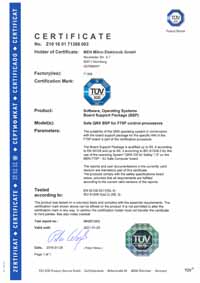
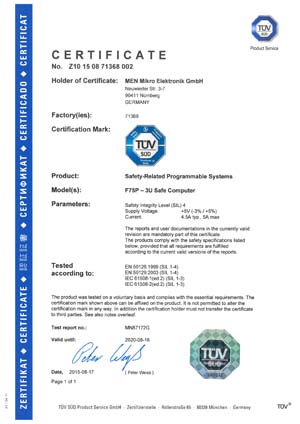
- TÜV Süd certified according to EN 50129 (SIL 4), EN 50128 (SIL 4) and IEC 61508 (SIL3)
- Full EN 50155 compliance
- -40 °C to +70 °C (+85 °C)
- Conformal coating
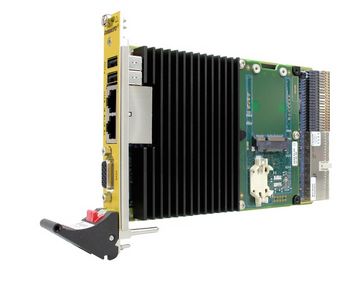
The F75P is a COTS safe computer with onboard functional safety that unites three CPUs on one 3U CompactPCI PlusIO card. It makes Intel Atom E6xx ("E600") performance with dual redundancy extremely compact, mainly targeting railway applications. Two independent Control Processors (CP) with independent DDR2 RAM and Flash and a supervision structure provide safety: For SIL 3 / SIL 4: With redundant software running on F75P and, e.g., with the software instances on the two CPs comparing their output. This way the board becomes a fail-silent subsystem, i.e. it can shut down in case of a fatal fault.
For up to SIL 2: Using just one of the two CPs or using both CPs independently for different applications. This way on each CP a 1oo1D safety application up to SIL 2 can be realized.
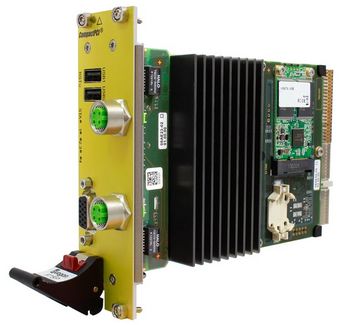
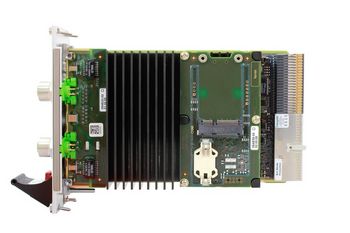
Its I/O Processor (IOP) is built up like a classic CompactPCI CPU board, including DDR2 RAM, front and rear I/O. The front connectors include VGA, two USB 2.0, and two 100-Mbit Ethernet channels. At the rear, the board provides another four USB 2.0, two Fast Ethernet ports, one 3-Gbit SATA and one PCI Express x1 link. These interfaces comply with the standardized pinout of CompactPCI PlusIO (PICMG 2.30). An onboard mSATA slot makes for scalable, robust mass storage. The intelligent board management controller of the IOP logs events such as reset, overvoltage or undervoltage in a non-volatile FRAM.
The Control (CP) and I/O Processors (IOP) communicate via internal links provided by an FPGA. The CPs are designed to run a deterministic real-time operating system such as the QNX Neutrino RTOS Safe Kernel. It is also possible to implement diversitary software on both kernels.
The F75P can replace multiprocessing systems with CPU redundancy and I/O by a small-footprint, low-power solution that is flexible for different types of application scenarios. It uses a single +5 V supply voltage to allow operation with external power supplies that do not generate +3.3 V.
F75P-based systems are generally certifiable up to SIL 4. Since the card has no voter of its own, the software implements and controls functional safety behavior. The customer can either add the software himself or purchase it from duagon. The safety features such as the CP supervisors are designed to SIL 4 according to [EN50129]. A railway certification package including the "safety case" document and a certificate from TÜV SÜD is available.
Its rugged set-up also make the F75P rail-ready: with assets like conformal coating and an operating temperature of -40 °C to +70 °C (10 min @ +85 °C) with qualified components, it is fully EN 50155 compliant. It is 6 HP and comes with RJ45 Ethernet connectors and a large heat sink.
Related Products
- With redundant CP usage: Certified to SIL 4 according to EN 50129 ("safety case" document and certificate from TÜV SÜD available)
- Tolerable functional failure rate per hour (TFFR) for safety functions: <= 1E-9 / h
- Without redundant CP usage: Certified to SIL 2 according to EN 50129 ("safety case" document and certificate from TÜV SÜD available)
- Tolerable functional failure rate per hour (TFFR) for safety functions: <= 1E-7 / h
- Control Processors configured for deterministic behavior, e.g., Hyper-Threading disabled, speed-step disabled, BIOS interrupts disabled
- Board maintains safe state after a failure (factory configuration)
- Three onboard processors
- Two Control Processors (CP)
- One I/O Processor (IOP)
- Inter-communication between all three processors via onboard Ethernet or Shared RAM
- Three identical processor types
- CPU support:
- Intel Atom E680T, 1.6 GHz, 400 MHz graphics frequency, 4.5 W TDP
- Main function of CPs
- Provide a "Safe Domain" on the board, including processors, memory, supervisors and power control
- Provide flexible implementation options for functional safety requirements
- Provide support for advanced, certified operating systems up to SIL 4
- Main function of IOP
- Provide common I/O and memory facilities
- Provide a user-friendly software interface and GUI
- 512 KB L2 cache integrated in E6xx for each processor
- System RAM
- Soldered DDR2
- 512 MB
- 1 GB (model 02F075P04)
- Boot Flash
- 2 MB
- 512 KB L2 cache integrated in E6xx
- System RAM
- Soldered DDR2
- 1 GB
- 2 GB (model 02F075P04)
- BIOS Flash
- 2 MB
- 8 KB non-volatile FRAM for event logging
- mSATA disk (for IOP boot image and file system)
- 320 or 400 MHz graphics base frequency, depending on processor type
- Maximum resolution: 1280 � 1024 pixels
- Video
- 1x VGA
- USB
- 2x USB 2.0, Type A, host
- Ethernet
- 2x 10/100BASE-T, RJ45 (model 02F075P00 / 02F075P02 / 02F075P04)
- 2x 10/100BASE-T, M12, D-coded, receptacle (model 02F075P01)
- LED
- Status: power status, board status (BMC)
- Ethernet: activity, link
- Reset button
- Four channels, 100BASE-T, via Inter-Communication FPGA
- SATA
- One channel, SATA Revision 2.x
- USB
- Four channels, USB 2.0
- Ethernet
- Two channels, 100BASE-T
- PCI Express
- One x1 link, PCIe 1.0a
- Compatible with PICMG 2.30 CompactPCI PlusIO
- 1PCI33/1PCIE2.5/1SATA3/4USB2/2ETH100
- Some pins are used for signals differing from the PICMG 2.30 specification. However, these signals do not destroy or cause any malfunction of a connected I/O board based on this standard.
- Three independent supervisors for Control Processors and Inter-Communication FPGA
- Check for overvoltage, undervoltage, excess temperature, internal errors of FPGA and CPUs, CPU and FPGA clock
- Watchdog, configurable as a window or timeout watchdog
- Board Management Controller for I/O Processor
- Event logging
- Event history logged in non-volatile FRAM, e.g., reset, overvoltage, undervoltage, excess temperature
- 256 entries possible
- Events are generated by board hardware or user application
- Real-time clock with supercapacitor backup connected to I/O Processor
- Data retention of supercapacitor: 56 hours when fully loaded, after 3 years runtime @ 40°C, 24h operation
- CompactPCI: CompactPCI Core Specification PICMG 2.0 R3.0
- System slot
- 32-bit/33-MHz CompactPCI bus
- V(I/O): +3.3 V (+5 V tolerant)
- Hot insertion and removal without damage
- Board can be supplied with +5 V only, all other voltages are generated on the board
- Backplane connectors used only for power supply
- Supply voltage
- +5 V (-3%/+5%)
- Power consumption
- 4.75 A typ.
- 5.25 A max.
- Dimensions
- 3U, 6 HP
- Weight
- 508 g (model 02F075P02/02F075P04, 6 HP, RJ45 connectors)
- Temperature range (operation):
- -40 �C to +70 �C, +85 �C for 10 min (EN 50155:2017, class OT4, ST1) (model 02F075P02)
- -40 �C to +55 �C, +70 �C for 10 min (EN 50155:2017, class OT2, ST1) (model 02F075P04)
- Conditions: airflow 1.5 m/s, typical power dissipation: 22.5 W
- Cooling concept
- Air-cooled (with tailored heat sink), or
- Temperature range (storage): -40°C to +85°C
- Relative humidity (operation): max. 95% non-condensing
- Relative humidity (storage): max. 95% non-condensing
- Altitude: -300 m to +3000 m
- Vibration (function): 1 m/s², 5 Hz - 150 Hz (EN 50155 (12.2.11) / EN 61373)
- Vibration (lifetime): 7.9 m/s², 5 Hz - 150 Hz (EN 50155 (12.2.11) / EN 61373)
- Shock: 50 m/s², 30 ms (EN 50155 (12.2.11) / EN 61373)
- Pollution degree: PD 2
- Fire protection: EN 45545-2, hazard level HL3
- Useful life: 20 years
- When integrated into an EMC protected rack
- EN 50121-3-2 / EN 55016-2-1 (conducted emission)
- EN 50121-3-2 / EN 61000-4-2 (ESD immunity)
- EN 50121-4 / EN 61000-4-2
- EN 50121-3-2 / EN 61000-4-3 (electromagnetic field immunity)
- EN 50121-4 / EN 61000-4-3
- EN 50121-3-2 / EN 61000-4-4 (burst immunity)
- EN 50121-4 / EN 61000-4-4
- EN 50121-3-2 / EN 61000-4-6 (immunity to conducted disturbances)
- EN 50121-4 / EN 61000-4-6
- I/O Processor
- Linux
- Control Processors
- QNX (with or without Safe Kernel)
Standard Models
Systems & Card Cages
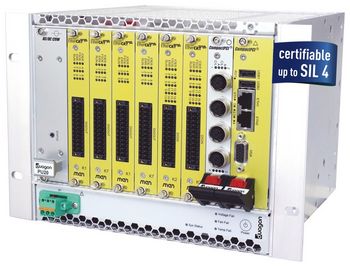
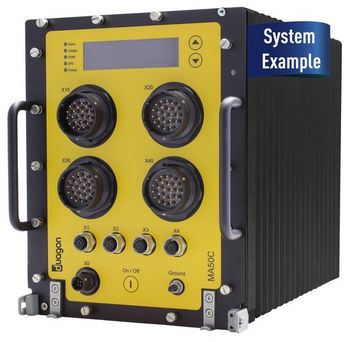
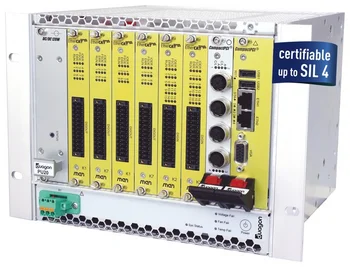
The product consists of the 40 HP basic system including backplane and mounting rails and provides:
- 1 slot for PSU
- 1 CompactPCI PlusIO slot for the CPU board
- 6 CompactPCI peripheral slots
- 1 CompactPCI peripheral slot reserved for F305
The barebone configuration comprises a number of standard, non-configurable components such as the PSU and CPU board. I/O boards are completely configurable. The Technical Data list all components that can be implemented in the system. Choose the functionality you need and contact duagon's sales team to verify which board combinations are feasible.
QNX
(PDF, 293 KB)
(PDF, 272 KB)
(PDF, 298 KB)
(PDF, 720 KB)
(PDF, 459 KB)

